Fresh from My Baptism by Paper
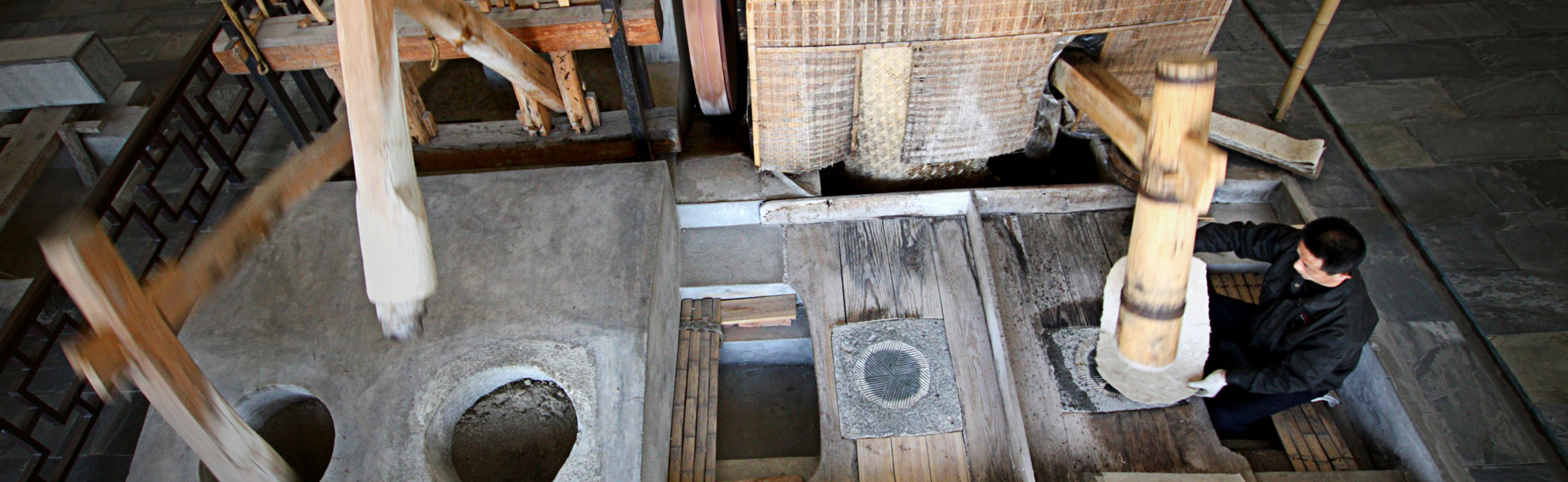
A beautiful Friday in April. Beams of sunlight filled the library through the windows as if they were drawing a pleasant bath while I watched the making of Xuan paper by the traditional method, demonstrated by two of only forty people in the world who can truly be counted as masters of this art.
I had just learned from a fellow observer, a precocious 6th-grade student, that what we were witnessing was only the last couple of steps in a process of exactly 108 steps when my old Director and friend, Mr. Ni, appeared at my shoulder and asked whether I had tried making it yet. When I told him there was a long line and that I probably would not get the chance, he decided to treat me to something just as special.
We went to the back of the library, where a cloth had been spread over a table. Mr. Ni took out some of the special paper and began to explain to me a few of the basics of Chinese calligraphy. I had always known that he was good. From my first days at SHSID nine years ago, when he was Director of the Middle School Section, I knew that along with birdwatching, calligraphy was one of his passions, and I was eager to learn.
Soon a small group of teachers arrived, including Ms. Chen, Jolin, Zhao Shuyi, and Ms. Zuo, and we all tried our hands with brush and ink on the amazing paper, so similar to that which was being made on the other side of the room. Then Mr. Ni himself sat down and began to write.
I say write, but really, he is more of an artist. His flowing script and bold, thick lines create a cursive style that is simultaneously strong and elegant. I was so calmed by watching him that I commented it felt as if I were watching the great Bob Ross paint a landscape in person.
We were each blessed to have our names written by him and given as gifts. Mr. Ni recoiled when I answered his question about my Chinese name and told him it was biànsèlóng (变色龙), “chameleon.” My homeroom teacher of 6-6, Ms. Zhou, explained along with him that chameleons can carry some negative connotations in Chinese. I said that was fine and that I did not mind, but after Mr. Ni wrote it once for me, he suddenly made a decision.
“No, Ben,” he said. “I will give you a new Chinese name. It is better.”
He took out some special paper, and with the careful twitching, pulling, and pressing of the vertical brush, that was that: my name changed from Biànsèlóng to Běn Xī Fú.
Later, when I asked what it meant, Mr. Ni explained that it was not meant as a literal translation so much as a closer phonetic rendering of my name, though he also had some fun with the individual characters. As he explained it to me, they could be read on their own as something like origin, west, and a character he playfully connected to Buddha by showing me how it echoed part of the full character. Smiling, he told me that it could mean, “Half Buddha Whose Origin is the West.” Whether this was strict linguistic science or Mr. Ni’s artistic generosity, I cannot say for sure, but I liked it all the same.
The document was made official with three stamps: one with the name of the artist; on some pieces, he signed instead with his nickname, “A Joyful Old Man”; one that called on me to follow my heart; and one shaped like a Han Dynasty roof-end tile, with the two seal-script Chinese characters for longevity (长寿) on it.
Mr. Ni then moved on to the other teachers who had gathered, giving each a special stamp, signature, or bit of flair to make every original piece tèbié (特别), special, in a way that belonged only to that person.
As I stepped back out into the spring sun, fresh from my baptism by paper, I could not help but marvel at the diversity of talent and character that we enjoy at SHSID, and at how lucky we are to have people like Mr. Ni who are not only willing, but glad, to share their passions with us.
And so, I left the library with ink on my fingers and a little more than that besides: newly named and properly stamped.
——Mr. Seevers